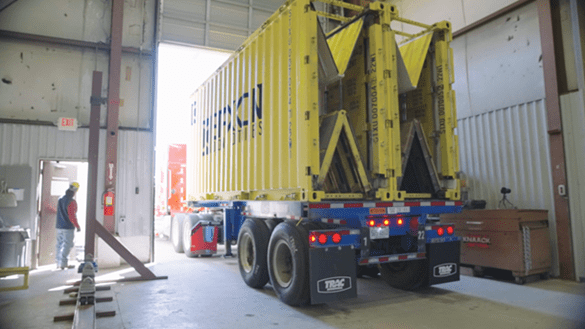
Ever heard of a collapsible shipping container? Neither had I until I was on LinkedIn reading about some of the latest innovations in business and saw a video of exactly this.
I thought, wow, how impressive. I must speak to the founders and discover how this innovation came about.
Having worked in logistics for much of my career, I know that the environmental and operational inefficiencies associated with shipping empty containers is costly. Until this business innovation, there has been no other way.
However, George Kochanowski founder and Richard Danderline, of Staxxon, had other ideas. They created the world’s first foldable, 100% interchangeable shipping container, and it offers a proven return on investment.
The perfect illustration of innovation in business.
Staxxon’s story perfectly illustrates the concept of innovation in business. It is an entirely new take on a problem for which others thought there was no solution.
Shipping companies just had to accept that they would be shipping empty containers forever. But George had other ideas. He was determined to solve this problem. As George puts it, he would figure out,
“How can we optimize the movement of nothing?”
George Kochanowski
He considered the problem facing not just one customer but a whole industry.
Their innovation has been hailed as revolutionary for the industry and described as;
‘Solving the shipping container conundrum, A design seen as a cure for logjams, easing supply chain woes, looking to the future, tackling supply chain chaos.’
My point is that they saw a seemingly ‘impossible’ problem that was exponentially costing shipping companies time and money, and they solved it. They saw and listened to what the industry needed.
Innovation in business is the cornerstone of sustainable revenue growth.
Long-term, sustainable business growth is the holy grail for all companies and innovation is the answer. But why do some companies find that innovation delivers results while others don’t?
- The first mistake companies make when thinking about innovation is that it must be momentous and big. But this isn’t the case. Evolutionary innovation strives to take the next step, making small but revolutionary changes to existing processes, services and products. Think LED lighting, QR codes, and contactless payments.
- The second is that some companies don’t align their strategy with their innovation. To grow revenue, you must understand the deeper problems of your future and existing clients. Think of Henry Ford’s assembly line; he wanted to make cars available to the masses, not just the elite few. He saw everyone as his potential customer. His production line transformed how he could manufacture specific elements, replicating them to the exact specifications repeatedly, saving himself time and money, which he could pass on to the consumer. Ford’s innovation in business went on to transform the whole manufacturing industry and beyond. His assembly line concept could be applied to every industry across the globe and is used today.
- Identify what you do well and play to your strengths. What are your strongest business capabilities? What do your customers know and love you for? Think of Apple. They are known for simplicity, functionality, and cutting-edge technology. Every product they launch is aligned with these concepts. They anticipate the market and design products that will not only push the boundaries of innovation but transform the way we live and work. Not to mention, they will grow market share and revenue growth.
The companies that follow these points, understand how innovation can lead to sustainable revenue growth. The companies that don’t have missed something VITAL.
The often-overlooked step that comes before innovation & revenue growth
“To be innovative, we can’t look to what others have done. The whole idea of blazing a path is that there was no path there before.”
Simon Sinek.
This quote from Simon Sinek sums up my thoughts on innovation perfectly.
I encourage this level of innovative thinking in business, incorporating it as a key theme in my work with clients to help them achieve breakthrough revenue growth.
However, innovative thinking or an innovative product in isolation will not deliver results in the long term.
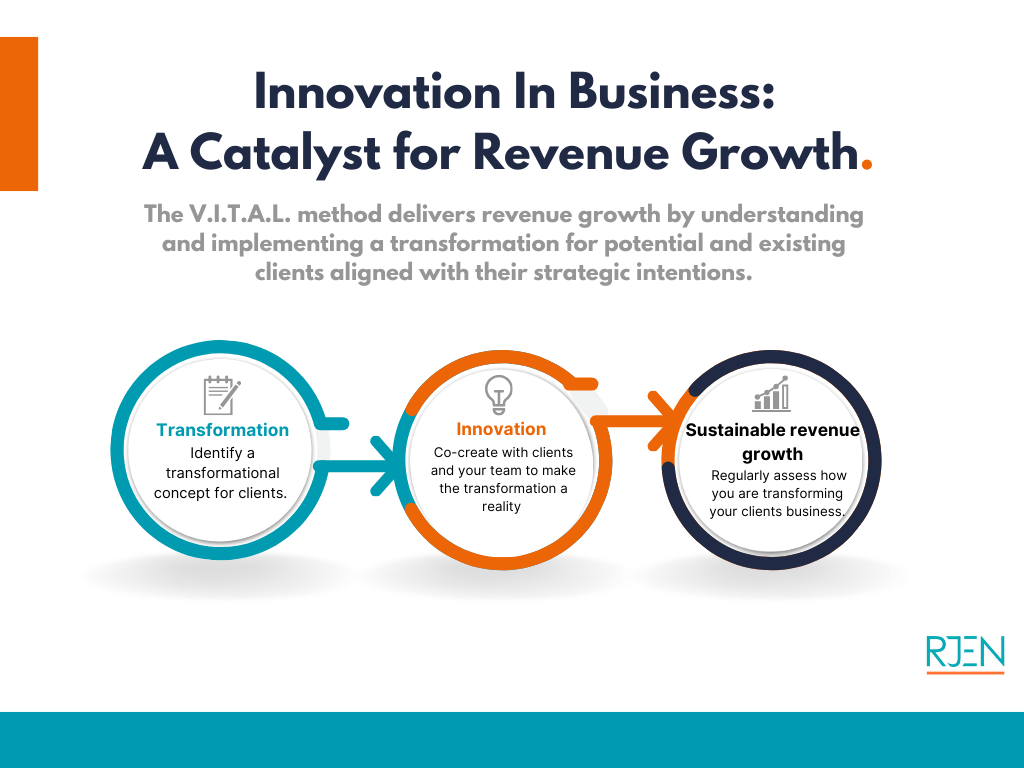
There is an often-overlooked step that comes before innovation and that is purpose, or as I call it a ‘Transformational concept’.
The Transformational Concept
A transformational concept provides a structured focus to your innovative thinking.
For example, George at Staxxon didn’t just wake up one day and think, ‘You know what, I’ll invent a collapsible shipping container’. No. His initial thought was, ‘It’s madness to ship empty containers; there must be a better way.’
This is what drove him to an idea, a concept that would transform the way the shipping industry worked “How can we optimize the movement of nothing?”
Once he had the concept, his innovative thinking and subsequent designs led him to create the container which ultimately led to sustainable revenue growth.
Innovative thinking can only begin when companies identify and understand the right transformational concept for their business.
Understanding which transformational concept leads to growth and innovation in business.
When I worked in logistics, we landed a prize account with retailer, The Body Shop. And while we provided exceptional results and service levels, they wanted more.
The Body Shop was ‘Fighting for a fairer, more beautiful world.’ They pushed the boundaries and they wanted us, as their provider, to do the same.
Under pressure to deliver something different, which we couldn’t comprehend what that might be, we dug deep into their mission, strategy and strategic intentions. The result was a transformational concept of developing the world’s first natural gas truck to deliver their products to stores.
Only then did we begin another round of creativity and innovative thinking into how we could make it happen.
Our innovative thinking and brainstorming enabled us to develop a transformational concept that delivered long-term, sustainable results and a 15 years partnership between my company and The Body Shop.
This is the V.I.T.A.L method, a unique and transformational approach to achieving results that deliver outcomes beyond expectations.
This approach requires a willingness to push the boundaries of what is possible.
Innovation in business is characterised by an entrepreneurial mindset, curiosity, creativity and a willingness to take risks, not to mention limitless resilience.
Entrepreneurs are adept at identifying opportunities, experimenting with new ideas, and learning from failures. Staxxon’s founders exemplify this mindset. By taking a risk on an unproven concept, they developed a product that has the potential to revolutionise the shipping industry.
We embraced failure
Not every innovative idea will succeed, but each failure provides valuable lessons. Businesses must nurture a culture where failure is seen as a step towards success, encouraging teams to take calculated risks.
When we discussed the idea of the natural gas truck with The Body Shop team, we had no idea if it was possible, or how we would make it happen.
But we were willing to try.
We faced many, ‘no this can’t be done from multiple truck manufacturers’.
Yet through our collaborative approach with our client, engineers and specialists we achieved it.
There were many failings and learnings along the way, which we took on the chin together.
Successful collaboration and co-creation with your team and with your clients.
Rarely a solo endeavour, innovation in business requires collaboration and co-creation within teams and with clients. Engaging customers in the innovation process ensures that the solutions developed are relevant and valuable.
For instance, Staxxon worked closely with industry stakeholders to refine its container design, ensuring it met the market’s needs. When I worked with retailer Next on their transformational concept, we worked closely with their team members, from the frontline to the executives. Co-creation with clients is essential.
The power of collaboration.
Collaboration brings diverse perspectives and expertise, leading to more comprehensive and innovative solutions. For innovation in business it’s essential to encourage cross-functional teams in the ideation process. This enhances their innovation capabilities through different perspectives and challenge.
Companies like Apple, Google, and even Ikea and Marriot are just a few examples of corporations using innovation labs and creating ‘play’ workspaces to nurture a culture of innovation and stay one step ahead. Their people are encouraged to collaborate and co-create to develop new ideas that will transform people’s lives and ensure the business remains the industry leader.
Innovation in Business: Conclusion
Innovation in business that creates transformational change resulting in revenue growth is a multifaceted process.
It begins with a deep understanding of customer problems. But for this process to be successful, you must initiate a structured approach like the V.I.T.A.L. methodology, adopt a growth mindset, and engage in collaborative efforts.
By embracing these principles, businesses can unlock new revenue opportunities and achieve sustained growth. Staxxon’s journey is a testament to the power of innovation in driving transformative change.
Frequently Asked Questions
Q1: Why is innovation a critical driver of business growth?
A: Innovation enables businesses to adapt, differentiate, and stay competitive in fast-changing markets. Without innovation, organisations risk stagnation as customer needs, technologies, and competitors evolve. Innovation does not only mean creating entirely new products; it also includes improving processes, finding more efficient ways to serve customers, and reimagining business models. For instance, companies like Netflix innovated by moving from DVD rentals to streaming, while smaller businesses innovate daily by responding creatively to client challenges. Innovation unlocks new revenue streams and ensures relevance in a crowded marketplace.
Q2: How does a business start building a culture of innovation?
A: A culture of innovation begins with leadership actively encouraging curiosity and experimentation. Employees need to feel that new ideas are welcome and that failures are treated as opportunities for learning rather than reasons for punishment. This can be supported by open communication channels, cross-functional collaboration, and recognition of creative contributions. When innovation is celebrated at every level of the company, it becomes part of the DNA of the organisation rather than an occasional project.
Q3: What role does leadership play in encouraging innovation?
A: Leaders act as both enablers and protectors of innovation. They create the conditions for innovation by setting a clear vision, allocating resources, and removing barriers that stifle creativity. For example, a leader might designate time for brainstorming sessions, invest in training that sharpens problem-solving skills, or champion pilot projects that test new ideas. Leaders also protect innovators by ensuring that risks are managed responsibly and by giving teams permission to explore unconventional approaches without fear of harsh consequences.
Q4: What are the common barriers to innovation and how can they be overcome?
A: Barriers include fear of failure, rigid hierarchies, and lack of time or resources. Many employees avoid suggesting new ideas because they worry about criticism or because they are too busy meeting immediate targets. Overcoming these barriers requires a mindset shift at all levels. Leaders must normalise risk-taking, allocate dedicated time for innovation, and create collaborative spaces where ideas can be shared openly. Companies that overcome these obstacles often adopt agile practices, test ideas on a small scale first, and scale up only once results show promise.
Q5: Can small businesses innovate as effectively as larger organisations?
A: Absolutely. In fact, small businesses often have advantages in innovation due to their flexibility and closeness to customers. They can make decisions more quickly, pivot faster, and experiment without the heavy bureaucracy that slows down larger organisations. For instance, a small consultancy can quickly adopt new digital tools to enhance client service, whereas a large corporation might take months or years to approve the change. What matters most is not the size of the company but the willingness to foster a mindset of adaptability and creativity.
Q6: How can innovation be measured to prove its impact?
A: Measuring innovation involves tracking both qualitative and quantitative outcomes. On the quantitative side, businesses can measure increased revenue from new products or services, cost savings from process improvements, or efficiency gains from adopting new technology. On the qualitative side, innovation can be measured through improved customer satisfaction, higher employee engagement, or greater brand recognition. It is important to remember that not all innovations show immediate financial returns. Some deliver long-term strategic value by building resilience and positioning the business for future opportunities.
Next steps
Gain further insights into propelling your business revenue, by any of the following ways below.
- Sign up to receive my V.I.T.A.L. insights newsletter for revenue growth
- Listen to the inspiring Staxxon story on our Lead To Succeed podcast here.
- Register for notification of future free live events about securing, sustaining, and scaling new business
- Connect with Rebecca Jenkins on LinkedIn
- Read my article about AI in Sales
About the Author
Rebecca Jenkins has extensive leadership and revenue growth experience. This includes securing, retaining, and growing multiple profitable client accounts in her previous business and for clients today.
Rebecca is a specialist consultant in B2B revenue growth and the author of Winning Big In Sales
Her award-winning V.I.T.A.L. method delivers results for businesses wanting a proven way to profitably increase revenue and secure long-term large client accounts. You can watch and read client case studies here on the RJEN website.