The visible challenge. The hidden constraint.
Six weeks ago, I sat with a CEO who had just presented her third missed forecast of the year.
The board wanted answers. All she could give them was a list of what was happening in the business.
Her leadership team had already doubled down twice. First, they recruited more salespeople. Then they implemented a new CRM. Neither moved the number.
“We’re doing everything right,” she said. “But it’s not working.”
I’ve heard that many times over the past twenty-five years. Across different businesses, sectors and leadership teams.
Yet the underlying issue is often remarkably similar.
The problem being worked on isn’t the problem that’s slowing growth. It’s the symptom, not the cause.
The default response to stalled revenue growth
When revenue becomes inconsistent, the instinct is understandable.
More effort, increased activity, improved reporting, recruitment investment, new technology, and new initiatives, most recently, the haphazard adoption of AI.
None of these decisions are inherently wrong, in fact, they may all be necessary.
The problem arises when solutions are introduced before understanding what needs solving. If the visible issue is only a symptom, no amount of activity will remove the underlying issue.
Therefore, slowed revenue performance is an outcome, not the problem.
Flat growth, missed forecasts and increasing price pressures are evidence that the problem exists somewhere else.
In this CEO’s business, the issue wasn’t capability, headcount or CRM adoption; it was the way strategic opportunities were being pursued.
There was no defined process for identifying stakeholders. Each account manager worked from instinct, engaging the people they knew best rather than those shaping strategy, investment and reducing risk.
The business hadn’t created a consistent way of developing strategic opportunities.
Signals that the commercial system is contributing to stalled growth
According to PWC, only 30% of CEOs are confident about revenue growth over the next 12 months, the lowest level in five years.* PWC
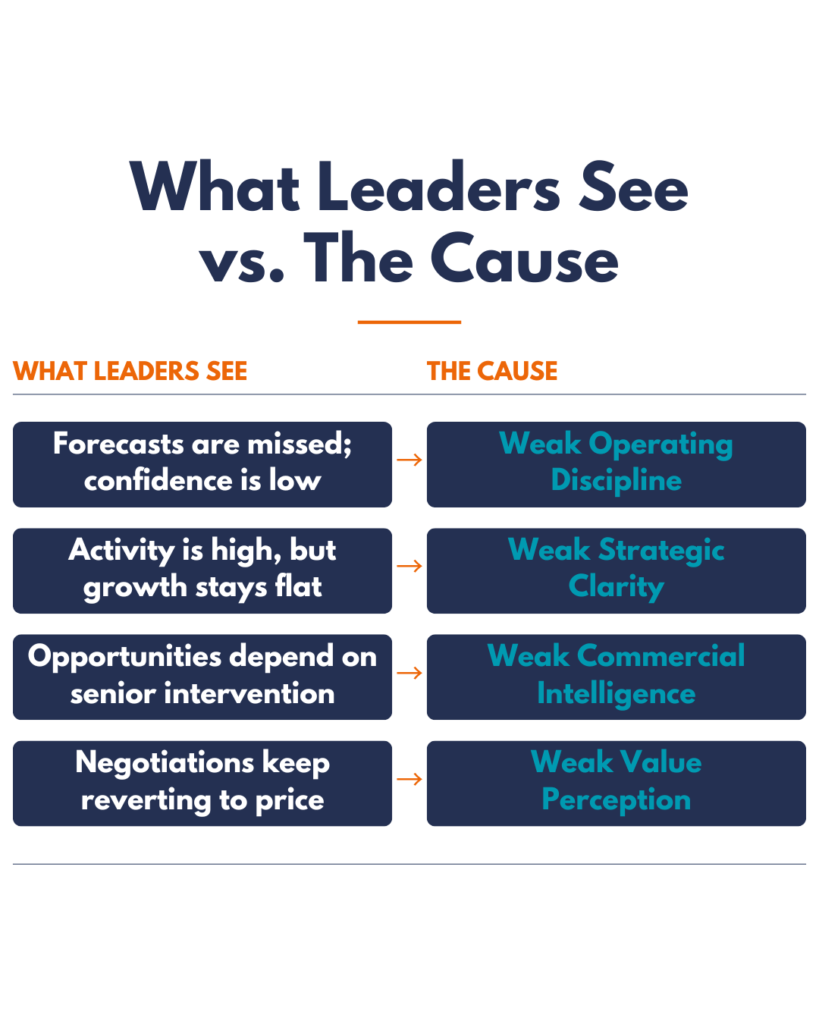
While organisations look very different on the surface, it’s not uncommon to see the following situations playing out in businesses experiencing revenue challenges.
- The leadership team spending more time rescuing opportunities than creating new ones
- Revenue forecasts relying more on confidence than evidence
- Buyers increasingly returning discussions to price rather than strategic value
- Teams are busy, but priorities aren’t always clear
- Client relationships appearing positive, yet revenue growth within existing accounts plateaus
- Growth depending heavily on a handful of experienced individuals
- AI maybe improving productivity, but not changing commercial performance
What lies beneath – Revenue Architecture
Over the years, I’ve come to believe that businesses rarely struggle because their people lack effort. More often, they’ve simply outgrown the commercial structure that supported earlier success. What helped a founder grow to £5 million in revenue won’t support their business at £20 million. What worked when relationships were informal becomes increasingly fragile as the organisation grows.
As businesses become more complex, growth depends less on individual capability and more on the quality of the system that supports it.
Revenue Architecture is the commercial structure beneath sustainable B2B growth. It’s the systems, standards, behaviours and discipline that make revenue predictable, scalable and repeatable.
Revenue Architecture helps leadership teams look beneath the symptom and identify which part of the system needs strengthening first.
It looks at the whole commercial system, not one function: how future growth is defined, how opportunities are chosen, how insight is gathered and used, how value is positioned, how strategic relationships are protected, and how execution is held together by standards and leadership discipline.
The Four Structural Conditions of Revenue Architecture for Scalable Revenue Growth
Sustainable growth depends on four conditions working together: Strategic Clarity, Commercial Intelligence, Value Perception and Operating Discipline.
When they’re strong, growth becomes predictable. When they’re weak, effort increases but revenue doesn’t follow.
Strategic Clarity
Alignment on where future revenue should come from, which opportunities deserve focus, and what must change first.
Commercial Intelligence
Understanding markets, buyers, stakeholders and decision dynamics deeply enough to create relevant commercial advantage.
Value Perception
Whether senior buyers and important clients see the business as strategically valuable, or just another supplier they compare on price.
Operating Discipline
The standards, evidence and leadership discipline that make good revenue behaviour and standards repeatable, not occasional.
Together, these four conditions are the core of a stronger revenue structure.
AI Adoption and Relationship Maturity & Trust Resilience
Revenue Architecture also builds the foundation AI needs.
According to a 2026 McKinsey podcast the level at which businesses adopt AI now, will shape competitive advantage for years.
Many organisations are turning to AI to improve commercial performance, but AI can only improve commercial decision making, once the system beneath it is proficient and aligned to business goals. Unclear priorities, unreliable data, or relationship knowledge will be accelerated with AI, not resolve it.
Therefore, it’s critical to address the question…
Is our revenue system mature enough for AI to improve our decisions, learning and scalability, rather than just our activity?
Trust needs the same discipline. In high value B2B decisions, growth is more resilient when trust and value are visible across an account, not held by a few individuals.
The questions leaders should be asking
Before we implement new software, recruit another salesperson or ask our teams to work even harder, ask yourself…
If revenue stopped growing tomorrow, would you know whether you were looking at the real problem, or simply the evidence that one exists?
It’s worth considering…
- Where should our next phase of growth come from?
- Which opportunities are consuming effort without creating strategic value?
- Where are we relying too heavily on individual relationships or executive intervention?
- Can we explain why important opportunities progress, or why they don’t?
- Has our commercial system evolved at the same pace as our ambition?
These questions will help identify what’s preventing revenue from becoming more predictable and repeatable.
Because once you identify the underlying constraint, everything else becomes clearer.
Investment becomes more targeted. Leadership decisions become more confident and growth becomes something you can deliberately design, rather than continually chase.
That’s the difference between treating revenue performance as the problem…
…and understanding it as the outcome of the commercial system beneath it.
This is what I call Revenue Architecture.
Revenue Architecture in action
The team at Cisco Systems had strong technical credibility and good client relationships, but conversations were not consistently reaching the level where strategic budget and senior sponsorship were released.
As a result, account growth had plateaued.
Identifying the Underlying Constraint
Using the Revenue Growth Diagnostic, it was evident that the team was credible, but its value was not always being positioned at the level of strategic relevance.
The issue was not technical capability. Rather, it was the ability to move from reactive problem-solving to proactive strategic partnership at senior level.
Operating Intervention
The V.I.T.A.L. Operating System™ was used to transform how account teams led client conversations, shifting the approach from product, service and problem resolution towards commercial insight, strategic relevance and executive-level value.
Commercial Outcome
As a result of this new approach, Cisco Systems
- Developed a seven-figure qualified revenue pipeline
- Secured a six-figure new business
- And embedded strategic account leadership capability across the team
The team realised that strong technical credibility is not enough if buyers do not see the strategic value. Growth changes when teams can connect capability to the commercial outcomes senior stakeholders care about.
A change in Cisco Systems Revenue Architecture was what they required.
“An outstanding programme that has empowered the team to create transformational growth on client accounts.”
Jordi, Former VP Sales, Cisco
If growth in your business has stalled, take the Revenue Growth Diagnostic to identify which condition is impacting your ability to develop a stronger revenue structure.
Next Steps
Click on the points below to access the content.
- Take the Revenue Growth Diagnostic
- Access your copy of the CEO Revenue Architecture Briefing – Trusted by CEOs. Backed by results. Built for today’s market.
- Register for notification of future free live events about leadership and securing, sustaining, and scaling new business
- Connect with Rebecca Jenkins on LinkedIn
- Is your Sales Forecast based on opinion read this article to find out more
About the Author
Architect Your Revenue Growth
Rebecca Jenkins helps mid-sized & enterprise B2B companies secure, scale, and sustain valuable client wins. Former FTSE-250 Sales Director; grew a logistics business to £55M; and secured £250M+ in B2B revenue.
Rebecca is a specialist advisor in B2B revenue growth and author of Winning Big In Sales.
Her award-winning V.I.T.A.L. method delivers results for businesses wanting a proven way to secure, scale and sustain profitable revenue growth. You can watch and read client case studies here on the RJEN website.