How would you describe your company culture?
Would you use the word ‘extraordinary’? Possibly, but I’m guessing the answer in most cases is no.
You might wonder why anyone would want to create an extraordinary company culture.
The answer is straightforward: because it can help deliver extraordinary results.
I’d like to share my thoughts around why that’s true and give some ideas on how to make it happen.
What is company culture?
Firstly, let’s examine what we actually mean by ‘culture’ (in the workplace sense).
Until it’s defined, company culture can feel pretty abstract. If we’re serious about harnessing its power to unlock the potential in an organisation, we need to have a more practical understanding of it.
Among thousands of definitions of company culture, my personal favourite is the simplest I’ve heard, often attributed to organisational consultants Deal & Kennedy:
“Culture is the way we do things around here.”
Deal & Kennedy
But, while simple, that definition doesn’t quite go far enough to be useful.
Breaking it down, “the way we do things around here” comprises a huge range of activity, at individual, team and organisational levels. This activity includes behaviours, values, methods, processes, rituals, decision-making, language, initiatives and policies. Consequently, your company culture – “the way you do things around here” – is the sum of these constituent parts.
It also helps to understand where culture can exist in an organisation, to appreciate how it drives success.
Company culture is so much more than social initiatives
Often people default to thinking about wellness or social initiatives when asked about their company culture. But culture isn’t just about yoga in the boardroom, summer parties or free breakfast cereal. These all have their place, but culture goes far deeper.
It exists in multiple touchpoints throughout the workplace: how you lead; your onboarding process; the way you communicate; how you work and interface with customers; your approach to developing your people etc.
Because all organisations have these touchpoints, it follows that all organisations have cultures, whether they want to or not. It’s just that some company cultures are intentional, carefully designed and actively managed to support their business goals. Conversely, some let their company culture do its own thing, evolving unsupervised (sometimes labelled as ‘organic’) into something that may or may not be helpful. This begs the question: if it’s something you can control, then why leave things to chance?
What is the most effective company culture?
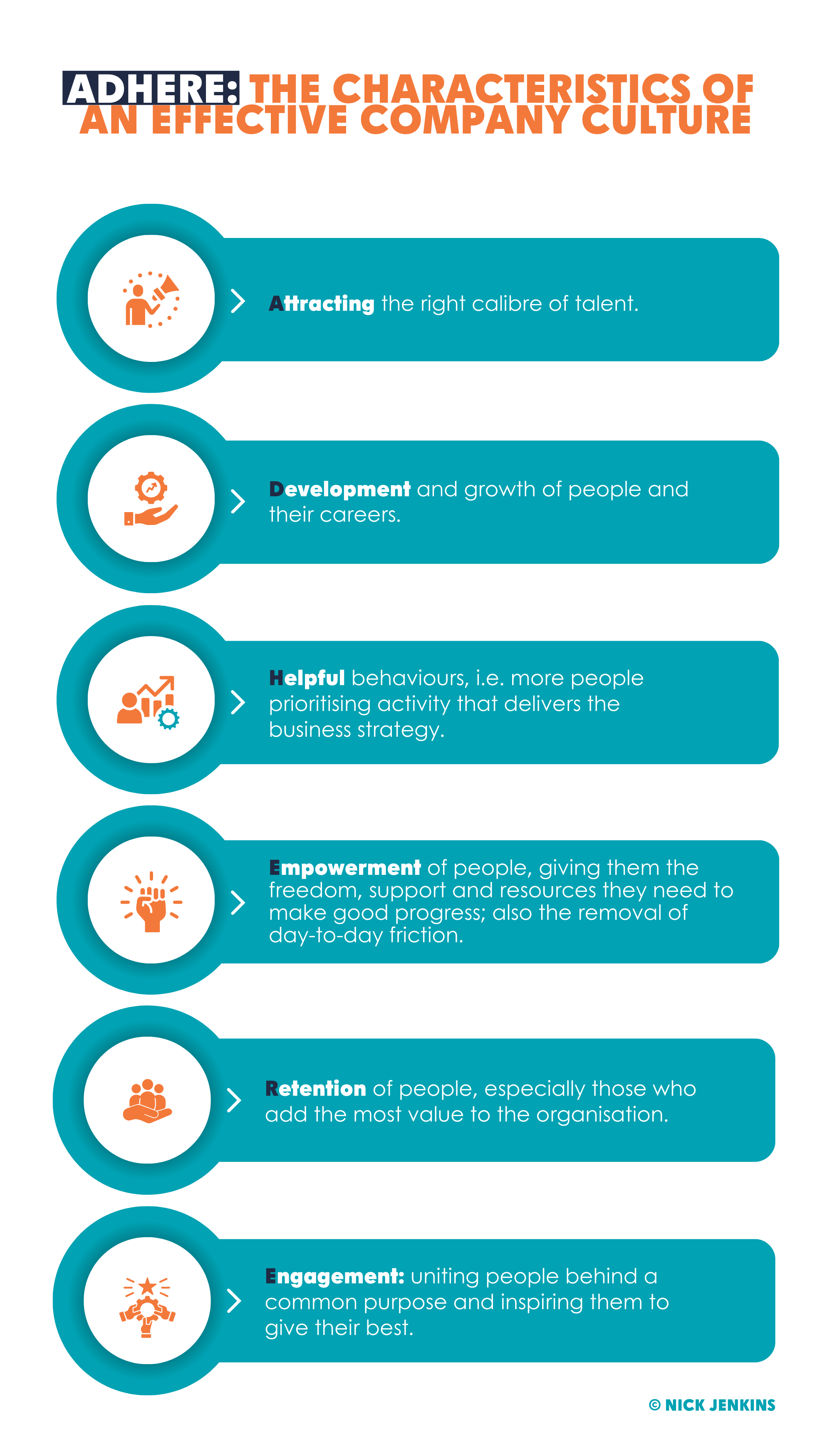
The most effective cultures – those that are extraordinary – are those that are intentional; successfully integrated into the most relevant touchpoints of a business, moving the needle in the critical areas that support success overall. My framework ADHERE is a helpful acronym for those critical areas:
- Attracting the right calibre of talent.
- Development and growth of people and their careers.
- Helpful behaviours, i.e. more people prioritising activity that delivers the business strategy.
- Empowerment of people, giving them the freedom, support and resources they need to make good progress; also the removal of day-to-day friction.
- Retention of people, especially those who add the most value to the organisation.
- Engagement: uniting people behind a common purpose and inspiring them to give their best.
Imagine ‘optimal’ in each of these areas for your organisation. When each one is in not just good but great, a company culture has truly moved beyond just ‘effective’ to ‘extraordinary’.
How to change company culture
So, if we know what we mean by company culture and we know what extraordinary looks like, how do we achieve that? The culture change process can be broken down into 5 steps:
- Prime people for cultural change. Clear communication with your people is important throughout the process, but especially at the beginning, to create buy-in and excitement. Explain that the ambition is to create an extraordinary company culture. Give a rationale for doing so (e.g. to support a new strategy, address specific cultural issues etc.) and explain that everyone will have a chance to help shape it.
- Understand the perspectives of your people. Designing a company culture should be a collaborative effort, involving and engaging the whole business. This could be via an employee survey or – better still – by speaking to people face-to-face. Ask them about the culture as it is now and how it should be. Listen carefully to what they say. If you are to optimise against each ADHERE characteristic, people’s input is essential. Questions should be along the lines of:
- What does a successful culture look like for us?
- Where are / aren’t we achieving that, and why?
- What cultural area is most important for us to focus on right now?
- Identify Common Themes. Once you’ve got the feedback, you can identify the common themes, factor in your own views and create your company cultural plan. What needs to happen? What are the quick wins? What are the longer-term tactics?
The more you can link the plan to the insights you get from your people, the more they will feel that you’re prioritising the right cultural areas. Plus, if the plan is genuinely co-created, people will be more emotionally invested in it.
- Provide Feedback. After contributing their views, people will want to hear back. Share the cultural plan and the feedback themes that helped inform it. This builds credibility and trust, especially if you’re able to acknowledge any themes where you’ve chosen not to take any action (as long as you give a sound rationale for why).
- Execute the plan. Fewer actions and initiatives done well is far better than many done poorly or in a way that overstretches people. Proper ownership, clearly defined success metrics and achievable milestones are all vital. Stick to the plan and deliver some quick wins to build momentum. Give regular progress updates to reinforce trust and credibility.
Summary
There are numerous factors that influence the success of an organisation. Many are unfortunately beyond our control. The good news is your company culture isn’t one of them. It’s something that any organisation, with the right vision, commitment and patience, can control and craft into something extraordinary. This is when it becomes a powerful tool – one that can drive extraordinary results.
The article was written by Company Culture Specialist Nick Jenkins.
https://www.linkedin.com/in/nickjjenkins
You can access a company culture assessment for free here, and get your score in 5 minutes.
Foot note from Rebecca Jenkins RJEN
We invited Nick Jenkins to write this article because of his expertise and because culture has a profound effect on achieving profitable revenue growth. If your team aren’t aligned or engaged with what is important in your business, it leads to unhappy clients, reputational damage and costly inefficiencies.
To learn more take the culture assessment and listed to the Lead To Succeed podcast episode 126 with Nick Jenkins.
Frequently Asked Questions
Q1: What is company culture, practically speaking, and why does it matter for results?
A: A popular definition is that culture is the way we do things around here, which includes the behaviours, values, language, rituals, decision methods, policies, and everyday processes that shape how people work. Culture shows up in leadership style, onboarding, internal communication, customer touchpoints, and how people are developed and rewarded. It matters because culture can accelerate or block strategic goals. When culture is intentional and aligned to the business strategy, it improves execution quality, consistency of decisions, and the customer experience. When culture evolves without guidance, performance becomes uneven and progress stalls. A deliberately designed culture becomes a force multiplier for results.
Q2: Why is it a mistake to equate culture with perks or social activities?
A: Perks can be nice, but they do not change how decisions are made or how people behave under pressure. True culture is embedded in how teams collaborate, how leaders communicate, how conflicts are handled, how customers are served, and how people are developed. A weekly yoga class cannot compensate for unclear goals or inconsistent management. Focusing only on perks risks creating cosmetic positivity while underlying friction continues. Sustainable improvements come from reworking the routines and systems that shape daily work, not from surface-level benefits.
Q3: What does an extraordinary culture look like and how does the ADHERE framework help?
A: Extraordinary cultures are intentional and integrated into critical parts of the business so they move the needle where it counts. The ADHERE framework outlines six focus areas.
Attract – bringing in the right calibre of talent.
Development – growing people and careers with real learning paths.
Helpful behaviours – people choosing actions that support the strategy.
Empowerment – removing friction and giving resources and decision rights so progress can happen.
Retention – keeping the people who add the most value.
Engagement – aligning people behind a clear purpose so they bring energy and commitment.
When each area is operating at an optimal level, culture shifts from acceptable to exceptional.
Q4: What are the five practical steps to change culture reliably?
- Prime people for change by communicating the ambition to create an extraordinary culture and why it matters now, and explain how everyone can shape it.
- Understand perspectives through surveys and engage in conversations to learn how the culture works today and what would make it successful.
- Identify common themes and convert them into a cultural plan with clear priorities, quick wins, and longer-term moves.
- Provide feedback by sharing both the plan and the insights that informed it, including reasons for areas you will not pursue.
- Execute with focus and ownership, define success measures, stage milestones, deliver early wins to build momentum, and give regular progress updates to maintain trust.
Q5: How can leaders measure whether culture is actually improving?
A: Use a balanced set of people and performance indicators linked to ADHERE.
Attract – track quality of hire, time to fill, and offer acceptance rates.
Development – track completion and impact of learning programmes, internal mobility, and readiness for key roles.
Helpful behaviours – define a few observable behaviours tied to the strategy and audit these in projects and meetings.
Empowerment – monitor decision cycle time and employee-reported friction points.
Retention – track attrition of high-value roles.
Engagement – use pulse surveys focused on purpose, clarity, and advocacy, then correlate changes with customer outcomes and financial metrics.
Q6: What common pitfalls derail culture change and how can they be avoided?
- Treating culture as a side project rather than a strategic workstream, which leads to fragmented initiatives with little impact.
- Launching many activities without clear ownership or measures, which overwhelms teams and dilutes attention.
- Asking for input then going quiet, which erodes trust quickly.
Avoid these by tying culture to strategic objectives, limiting initiatives to a manageable portfolio with named owners and success criteria, and closing the loop with frequent, transparent updates about what is changing and why.
Q7: How can an organisation embed new cultural behaviours so they stick?
A: Here are some suggestions.
- Embed behaviours into routines and systems.
- Translate desired behaviours into hiring criteria, onboarding experiences, manager playbooks, meeting norms, and performance reviews.
- Recognise and reward people who model the behaviours, and coach quickly when gaps appear.
- Equip managers with simple conversation guides so they can reinforce day to day.
- Tell internal stories that highlight real examples of the culture in action.
When the behaviours are reflected in how work is planned, led, and evaluated, they become the default, not an aspiration.
NEXT STEPS
- Sign up to receive my V.I.T.A.L. insights newsletter for revenue growth
- Register for notification of future free live events about securing, sustaining, and scaling new business
- Connect with me on LinkedIn
- Read my article 7 red flags that need addressing for your revenue growth strategy
About the Author
Rebecca Jenkins has extensive leadership and revenue growth experience. This includes securing, retaining, and growing multiple profitable client accounts in her previous business and for clients today.
Rebecca is a specialist consultant in B2B revenue growth and the author of Winning Big In Sales
Her award-winning V.I.T.A.L. method delivers results for businesses wanting a proven way to profitably increase revenue and secure long-term large client accounts. You can watch and read client case studies here on the RJEN website.
For further insights from Rebecca Jenkins, click here