AI in B2B sales is changing how buying decisions are made and exposing which account relationships were never strategic to begin with.
In most B2B markets, only 5% of potential buyers are actively in‑market at any time, while the rest are researching, aligning stakeholders, or simply doing nothing. Buying committees now include 6–10 people, most of whom are risk‑averse and misaligned, and 77% of B2B buyers describe their last purchase as difficult (Gartner). AI is entering this already complex landscape as a new gatekeeper, not a shortcut.
As AI increasingly acts as an intermediary in B2B buying decisions, organisations are asking:
“How do we sell to AI?”
But that’s not the right question. We should instead be asking:
“Which of our accounts are robust enough to survive AI-driven buying and which are about to be commoditised?”
The answer lies not in technology, but in account maturity.
In high‑value B2B decisions, trust has become the tipping point: 80% of B2B buyers say trust in the vendor influences their final decision more than price (Edelman Trust Barometer). AI may optimise options, but humans still decide who they trust enough to back in the boardroom.
The ability to win strategic clients and move transactional sales to the status of client transformation is critical and one of the four components I address through my Revenue Architecture System.
Human Buyers vs AI Buyers: A Structural Shift
By 2028, 90% of B2B buying will be AI agent intermediated (AI-CTO.IO) and sellers who are already incorporating AI into their workflows are 3.7 times more likely to meet their targets. The efficiency gains are obvious and shifts in buying behaviours are inevitable.
Understanding the fundamental differences between AI buying agents and human buyers at different stages of the account is critical:
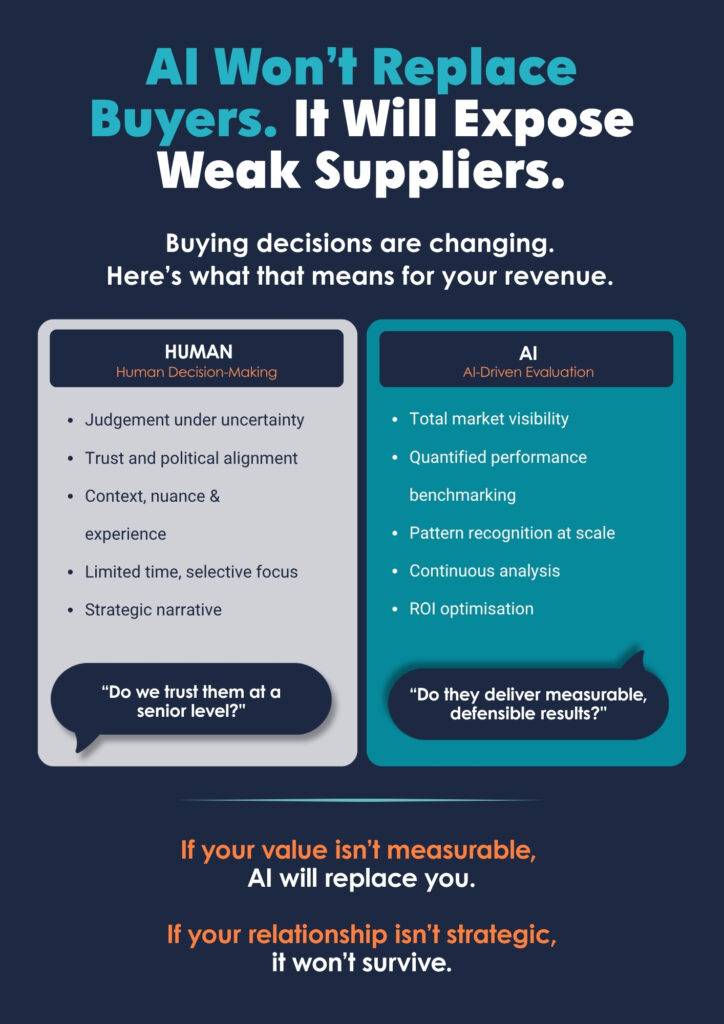
This matters because AI removes the emotional buffer that once protected weak relationships.
What impact does AI in sales have across the five Account Maturity Stages?
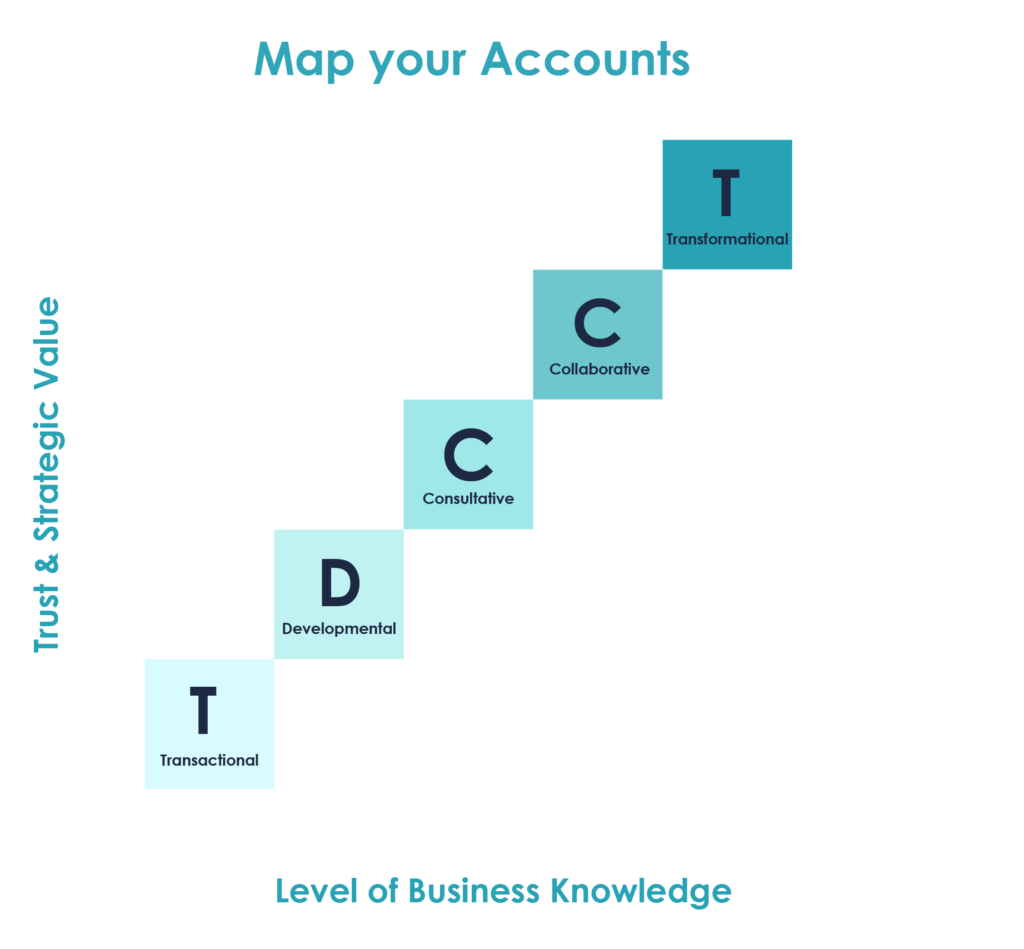
1. Transactional
AI buyers thrive, suppliers churn
Transactional accounts are defined by:
- Task-based engagement
- Price-led decision-making
- Limited understanding of the client’s wider business
These are exactly the conditions in which AI buyers dominate.
AI buyers:
- Compare features, pricing, and delivery at scale
- Optimise ruthlessly for cost and efficiency
- Replace suppliers without emotion or hesitation
In a transactional model, there is no human relationship to defend margin or continuity.
In fact 33% of all buyers already prefer to complete purchases without direct contact with sales teams. ( AI-CTO.IO)
CEO implication:
If an account is still transactional, AI will squeeze margins or remove you entirely. It’s crucial that at this stage you compare with AI’s ability to gather deeper insights into the client’s business, their clients, sector and competitors. If nothing differentiates you beyond price and delivery, then the account is already exposed.
Ask yourself: If AI stripped emotion from this account tomorrow, would anything defend our position?
2. Developmental
AI exposes whether “reliability” actually creates differentiation.
At this stage, suppliers are recognised as dependable and capable of adding value. Growth begins, but is still narrow and functionally confined.
AI buyers can:
- Measure reliability objectively
- Benchmark performance against alternatives
- Detect incremental value, but only within defined scopes
CEO implication:
Without deliberate leadership, AI locks these accounts into a “good but replaceable” status. What AI cannot do is decide that reliable and credible delivery should evolve into partnership status. That step remains human-led.
Asked yourself: Are we valued for outcomes, or merely tolerated for delivery?
3. Consultative
AI informs decisions, humans shape direction.
Consultative relationships involve:
- Multi-area engagement
- Ideas being invited, not just execution
- Growing strategic dialogue
Here, AI buyers and human buyers coexist.
AI handles:
- Data evaluation
- Scenario modelling
- Risk scoring
Humans still:
- Interpret strategy
- Navigate organisational complexity
- Decide which insights matter
This is where human sellers begin to offer value, not as presenters of information, but as strategic advisors.
CEO implication:
This stage requires capability uplift. Having the right team in place to lead strategic conversations is crucial. Insight without the ability to influence stalls progress.
Ask yourself: Are we having strategic or operational conversations at c-suite?
4. Collaborative
AI informs strategy; humans manage commitment.
Collaborative accounts involve:
- Joint planning
- Long-term vision
- Senior stakeholder engagement
AI buyers are now embedded within the client organisation but they do not own accountability.
Humans remain essential to:
- Align goals
- Manage ambiguity
- Lead executive cadence
- Balance optimisation with long-term strategy
AI can recommend.
Only humans can commit.
CEO implication:
The key question here is whether you have strong enough executive-level relationships to shape direction and validate activity
Ask yourself: Who in our organisation actually owns the future of this relationship?
5. Transformational
AI offers foresight. Humans create futures.
Transformational relationships go beyond buying and selling:
- Co-creating future state
- Tackling future risks
- Shaping innovation
- Operating at CXO and board level
AI buyers contribute:
- Scenario modelling
- Long-range data insight
But they cannot:
- Set ambition
- Navigate politics
- Build trust at senior executive level
- Lead organisational change
This is where human sellers become strategic partners, not vendors.
CEO implication:
AI strengthens these relationships but it does not and cannot replace them.
Ask yourself: Are we embedded, at board and CXO level, as a critical partner for the long-term future of this account?
The Enduring Role of the Human Seller
The rise of AI buyers does not eliminate human sellers, it filters them.
Human value concentrates in four areas that directly map to higher account maturity:
- Strategic Partnership Design
Complex, long-term, transformational deals still require trust, creativity, and judgment. - Governance of AI Systems
Humans must configure, oversee, and align AI agents to strategic outcomes on both sides. - Navigating the Undefined
AI excels within rules. Humans lead when the rules no longer apply. - Executive Relationship Leadership
As AI manages transactions, humans manage futures.
The Real CEO Question
AI buyers are not a future problem, they are a present accelerator.
They will:
- Reward mature, strategic account models
- Destroy fragile, transactional ones
- Compress the middle where intent is unclear
The organisations that win will not be those that “sell to AI best”, but those that use AI to move their most important accounts into the transformational level
The result is that account maturity is no longer a “nice to have”.
It has become a structural requirement for relevance.
Using the RJEN Key Account Transformation Diagnostic
The diagnostic helps leadership teams answer one vital question in relation to AI in B2B sales:
Are our most important accounts resilient in an AI buying environment, or vulnerable to commoditisation?
Summary
AI will increasingly determine how buying happens.
But it will not decide:
- Who is trusted
- Who is invited for the long-term
- Who shapes outcomes
- Who remains relevant over decades
That responsibility sits squarely with leadership.
AI will not decide who matters.
But it will ruthlessly expose who never did.
Next Steps
Click on the points below to access the content.
- Access your copy of the RJEN Key Account Diagnostic
- Register for notification of future free live events about leadership and securing, sustaining, and scaling new business
- Connect with Rebecca Jenkins on LinkedIn
- Read my insights on whether your business is ready to win large clients
About The Author
Architect Your Revenue Growth
Rebecca Jenkins helps mid-sized & enterprise B2B companies secure, scale, and sustain valuable client wins. Former FTSE-250 Sales Director; grew a logistics business to £55M; and secured £250M+ in B2B revenue.
Rebecca is a specialist advisor in B2B revenue growth and author of Winning Big In Sales.
Her award-winning V.I.T.A.L. method delivers results for businesses wanting a proven way to secure, scale and sustain profitable revenue growth. You can watch and read client case studies here on the RJEN website.